
Weather here in Central Texas is not kind to wood buildings. Hot summer sun can cause wood to warp and crack. Straight-line winds can blow siding off of pole barns. Flash rainstorms can cause wood to begin to rot within 24 hours. Termites and other wood-eating insects can destroy framing before you even realize what’s happening. If you’ve ever had to rebuild your hay barn multiple times, you understand the headache.
Enter the shipping container. These strong boxes, made of Corten steel and designed to be carried on ships, were built with weatherability in mind. Rust-proof? Check. Fireproof? Check. Insect-resistant? You bet. Container barns can also be used for many purposes with some clever design. From barns to workshops, tack rooms, or equipment shelters, the possibilities of using 20ft and 40ft containers are almost endless.
On this page we’ve compiled a few container barn plans that we feel are ideal for use here in Central Texas. From ranching on 50+ acres outside of Dripping Springs to small horse properties near Wimberley, we have you covered.
Why Container Barns Make Sense in Central Texas
Weather-Resistant in Texas Weather
Corten steel is formulated to develop a consistent, protective layer of rust that actually prevents more rust from forming. Your container barn will be able to withstand hail, straight-line winds, and even incidental exposure to wildfires while maintaining structural integrity that simply can’t be matched by a traditional stick-built outbuilding. While a pole barn may lose its roof to a summer thunderstorm, your container will not budge.
If Termites/Ant/Rot Had A Meeting In Texas…
Traditional wood-frame barns are fighting subterranean termites, carpenter ants, and moisture-related rot their whole lives – especially barns with any wood in ground contact. Boxes take that fight out of the equation. No wood for termites to munch on, no organic material for rot and decay, and no annual pest control bill.
Quick Build Time
Traditional barn construction takes time. Permitting, foundations, framing, roofing, interior finishing. You get the idea. With a container barn, your structure arrives on a truck, ready to go. Site work, placement, and basic modifications can be done in a fraction of the time, so your equipment, livestock, or hay is covered before the next Texas storm.
Top 4 Shipping Container Barn Layout Ideas
Farm Barn Design Idea #1: Classic Texas Center-aisle Barn (Container Hybrid)
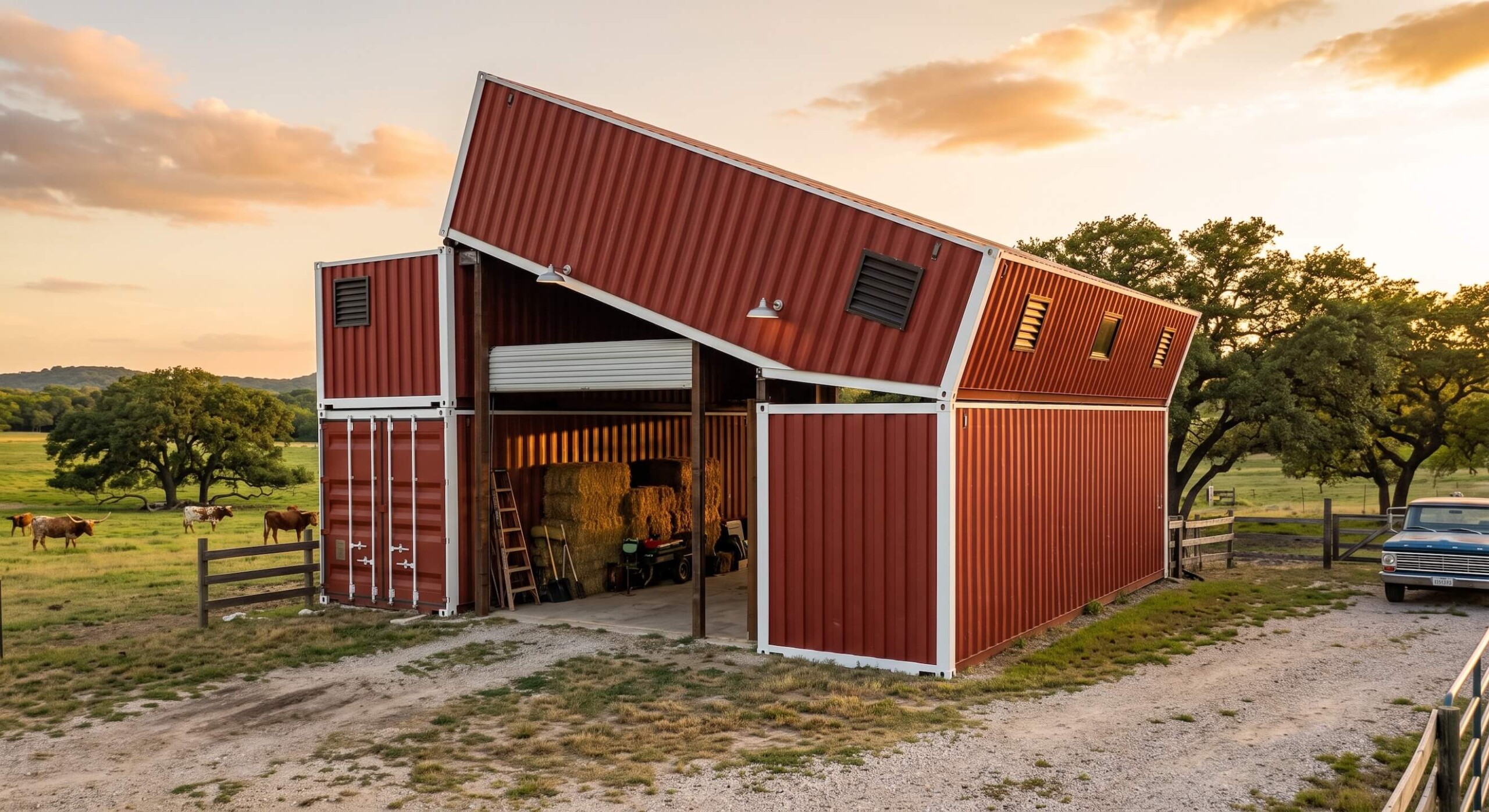
Design: Space two containers (can use either 20ft or 40ft) parallel to each other approximately 12-20’ apart. Install a gabled roof or metal truss roof across the space between containers. Containers create two enclosed storage bays with a covered center aisle for a shaded work area, implement parking area, or livestock walkthrough.
Ideal Use: Tractor/storage/hay/feed bays or general multi-use farm/utility gathering space where secure lockup and a covered work area are needed.
Texas Advantage: That aisle! It’s a built-in breezeway. Grabbing any available cross-breeze is key to surviving summer temperatures in July and August. If you line that aisle up with prevailing south- southeast breezes, you’ve designed in passive air conditioning from the start.
Idea #2: The Livestock Run-In & Tack Room Combo
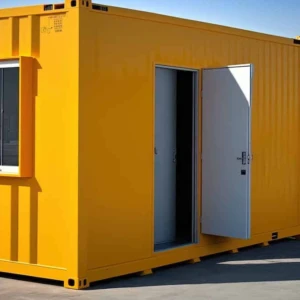
Design Breakdown: Take your basic 40ft container and divide it into two rooms. Leave one side completely intact with lockable cargo doors or install a man door for tack/feed/supplements/tools. Cut several large openings in one of the long sides of the other half to create a sheltered run- in for horses (or cattle, goats, sheep) to get out of the sun and rain.
Ideal Use: Hobby horse farms and sheep/goat ranches around the Hill Country that are looking for an economical shelter option that doesn’t have a huge footprint or budget. Many of our customers choose this design because they want their feed storage and livestock covered in one building instead of two separate outbuildings.
Idea #3: The Heavy Equipment & Workshop Barn
The Setup: Place 2 or 3 40ft High Cube containers in a U-Shape or L-Shape configuration to create an enclosed courtyard. Each container offers lockable, weather-tight storage for high-value equipment. The courtyard creates an open-air workspace for equipment repairs, welding, or staging. A roof structure can be added over the courtyard if desired.
Ideal for: Ranchers and country homeowners who need heavy-duty lockup storage for skid steers, ATVs, welding machines, generators, and ranch equipment. The courtyard setup is also great for contractors storing equipment at a rural job site.
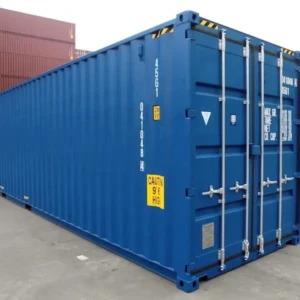
HIGH CUBE containers are the same as regular containers except they have one foot of extra height inside the container. This comes in handy when stacking tall equipment or building shelves/rack/tool hangs overhead.
Idea #4: The Mini “Barndominium” (Storage + Office/Living)

Designate ONE HALF of a shipping container (or ONE CONTAINER in a multi-container build) for farming/ranch storage. COMPLETELY seal the other half of the container with spray-foam insulation, mini-split AC, windows, and basic finish. Voila! You have yourself a ranch manager’s office, weekend breakroom, or temperature controlled space to store sensitive equipment/products.
Best Used For: Anyone that spends DAYS on end working on their land/business and needs a comfortable place to ‘hangout’ without investing in a building. Perfect for Hunting Ranches, Agritourism, or simply a Rural Home where you need some usable space but don’t want to invest in a traditional structure.
Central Texas-Specific Design & Build Considerations
Central Texas is a battle when it comes to beating the heat. Address cross-ventilation in your designs from the beginning and avoid costly retrofits and high energy bills.
| Consideration | What to Keep in Mind for Central Texas |
| Heat Management | Insulate interior walls and ceiling with closed-cell spray foam. Use reflective or light-colored exterior paint to minimize solar heat gain. Install solar-powered ridge vents or whirlybird turbine vents to passively vent hot air from your building. |
| Foundation & Soil | Situated on vast stretches of clay soils—particularly in the Blackland Prairie region of Central Texas—floors can heave when wet and settle when dry. Avoid setting your container directly on grade. Use a compacted gravel pad, concrete piers, or railroad tie foundation to keep your building level and provide clearance for drainage. Check with your county’s development services office to learn about permitting requirements. Requirements change from county-to-county in Central Texas. |
| Permitting & Ag Exemptions | Travis, Williamson, Hays, and Bastrop counties may have different regulations regarding accessory structures, property setbacks, and even codes specific to container homes. If you have an agricultural exemption on your property, you may experience fewer restrictions. However, it’s always best to check with your county first. |
Essential Customizations & Add-Ons
Overhangs & Lean-To Porches
The simplest container mods are roof overhangs and lean-to roof extensions. By adding a porch on one or both long sides of your container, you get not only extra shaded space for cattle to loaf or for implementing parking, but also a bit of outdoor workspace. That little bit of extra shade in Central Texas can reduce ground temperatures by 15 to 20 degrees around the container—making a huge difference for livestock comfort and preservation of stored items.
Roll-Up Doors
While standard swing-out cargo doors are fine for walk-in accessibility, they’re a nuisance when you’re constantly driving a tractor, ATV, or truck in and out. Replacing one or both ends with a heavy-duty roll-up door, or cutting your own roll-up into a long side, creates drive-thru accessibility that makes your container vastly more useful as a working barn or equipment/storage bay.
Ventilation
Did you know that shipping containers are purposely built to be completely airtight? That’s great news for weatherproofing and pest prevention, but not so much if you’re looking to keep things ventilated. Installing louvered vents near the roof peak, cutting screened-in vents into the sides, and adding turbine vents to the top are all easy ways to improve airflow. Bonus: good ventilation is critical for livestock shelters to keep animals healthy and prevent mold/mildew buildup on stored feed and hay.
Start Your Container Barn Project
A container barn utilizes the strength, security, and heat resistance unrivaled by traditional building methods. In Central Texas, where weather can wreak havoc on property year-round, maintenance-free material has become key. No matter your application, from a basic run-in to multiple stalls with a center aisle for horse facilities. Shipping containers can provide you with a steel shell to work with and mold to your specifications.
So where do you begin? At Steel Box Containers, we have a variety of new and used 20ft and 40ft containers ready for shipment anywhere in Central Texas. Need one container for a tack room? How about 6 High Cubes for an entire horse barn? We can assist you in finding the correct containers for your project.
Call today to get a quote on high-quality containers delivered to your fence row. Speak with one of our experts about your barn design.