Fed up with purchasing that decaying wooden shed every few years? If you’re a homeowner, small business owner, or farmer in Central Texas that has had it with sub-par storage, there is a better way. Shipping containers are among the most secure, sensible, and long-lasting storage buildings available on the market. This all-in-one guide will help answer every question you have about using a shipping container as a shed—especially if you’re in the Austin metro area and surrounding Hill Country.
TL;DR:
Shipping container sheds are the best storage shed option ever. Made of steel, they are rot-proof, warp-proof, and require zero maintenance. Longevity of 25+ years. Security, weatherproofing, and overall toughness is far superior to wood, which rots, warps, and needs constant maintenance.
Key advantages: Comes pre-built (no DIY disasters), insanely secure (14-gauge steel walls), endlessly customizable (add doors/windows, electricity, etc.), portable, and environmentally-friendly. Built to handle Central Texas heat, hail, and flash floods without breaking a sweat.
Trade-offs: Up-front cost is higher than a $100 wood shed, but the TCO is dramatically lower. May need a permit (depends on location). In Central Texas, impervious cover limits, HOA rules, and county vs. city regulations all factor into placement—we break it all down below.
The bottom line: If you’re sick of having to replace plastic and flimsy wooden sheds every few years, a shipping container is a one-time investment that fixes every storage issue. Comes in 20ft or 40ft sizes, and can be rented or bought.
Shipping Container Shed Defined
By definition, a shipping container shed is an ISO-standardized steel freight container (typically 20ft or 40ft) that has been weatherized and retrofitted for on-site storage. Containers are the best in class for security and toughness as sheds, leaving other materials such as wood in the dust. Storage sheds made from containers are ready-to-go right off the truck with reinforced steel construction, marine-grade plywood flooring, and heavy-duty cargo doors. You get a premium structure built to survive hurricane-force winds, saltwater corrosion, and decades of abuse.
Problems with Normal Sheds
Why are shipping containers the best alternative to traditional wooden sheds? To explain that, we first need to discuss how and why wood storage buildings let you down.
Decay
Problem: Wood is an organic material which means it has an expiration date before it starts to decay. Even pressure-treated wood will eventually succumb to moisture exposure, especially where the base of the structure meets the ground and at seams where moisture is prone to accumulate. After a few years of service you will begin to notice soft spots, discoloration, and structural weakness that will only get worse over time.
Solution: Steel is impervious to biological decay. A shipping container will not rot, no matter how much exposure to rain, snow, humidity, or dirt it experiences. The corrugated steel walls also retain their structural integrity for decades without the same degradation you see in wood. In Central Texas, intense UV radiation also dries out, warps, and cracks wooden shingles and siding long before rain rots them—steel handles that UV exposure without any structural degradation.
Self-Assembly
Problem: Buying a shed kit means you are going to spend an entire weekend (or more) assembling hundreds of individual pieces with instructions that might as well be in another language. You will need specialty tools, a couple of extra hands, and infinite patience to troubleshoot missing pieces or things that just don’t fit. One small error in assembly can compromise the structural integrity of the entire building.
Solution: Shipping containers come fully assembled and ready for use immediately upon delivery. Once it’s on your prepared site, your container shed is ready to go and put to work. No tools needed and no assembly headaches or second-guessing whether you put it together right.
Secured
The Problem: Standard sheds are notoriously easy to break into. Thin walls have simple padlock hasps that are pried open with a screwdriver. Your expensive equipment, tools and machinery are unsafe from thieves.
The Solution: Thick corrugated steel walls of a shipping container resist prying, cutting and forced entry. Industrial-grade locking mechanisms are orders of magnitude more secure than traditional sheds. Optional lockbox (security shroud) completely encases the locking mechanism for added security.
Warping
The Problem: Wood swells, shrinks and deforms with changes in temperature and humidity. Eventually, the warping causes doors to stick, windows to jam, and other structural components to shift out of alignment. What begins as a minor inconvenience quickly turns into a shed you can’t use correctly.
The Solution: Welded steel frame of a shipping container never shifts, twists or warps no matter the weather conditions. Doors continue to open and close smoothly for decades. Precision-engineered design holds everything perfectly in place.
Maintenance
The Problem: Wooden sheds require constant upkeep. You’ll have to repaint, reseal, replace shingles, treat for pests, and repair rotted sections every few years. This routine maintenance is a huge cost in time and money over the life of the shed.
The Solution: Shipping containers need little to no maintenance. A periodic visual inspection for surface rust and occasional touch up with rust-preventive paint is all that’s required. Steel construction is naturally pest resistant, has no shingles and requires no sealing or staining.
Benefits of Using a Shipping Container Shed
Shipping container sheds offer several unique advantages over traditional shed designs that make them an increasingly popular choice for both homeowners and businesses. These include:
Durability
Shipping containers are built to withstand some of the harshest environments on the planet. Designed to be stacked nine containers high while fully loaded with up to 67,000 lbs., and transported thousands of miles across tumultuous seas and through salt spray and extreme temperatures, the construction of a shipping container means unmatched durability and longevity on your property. A well-maintained shipping container shed can easily last 25+ years and outlive multiple traditional sheds. That toughness translates directly to Central Texas conditions, where heavy steel walls stand up to massive hail storms and torrential downpours without puncturing, shifting, or rotting at the ground line the way wooden skids do.
Security
When you need to protect valuable equipment, tools or inventory, nothing is more secure than 14-gauge corrugated steel walls and commercial-grade locking systems. Shipping containers are made to keep high-value cargo secure during international transit and that same level of protection and security will keep your belongings safe on your property. The top-level security many insurance companies will offer lower premiums for items stored in a container.
Customisability
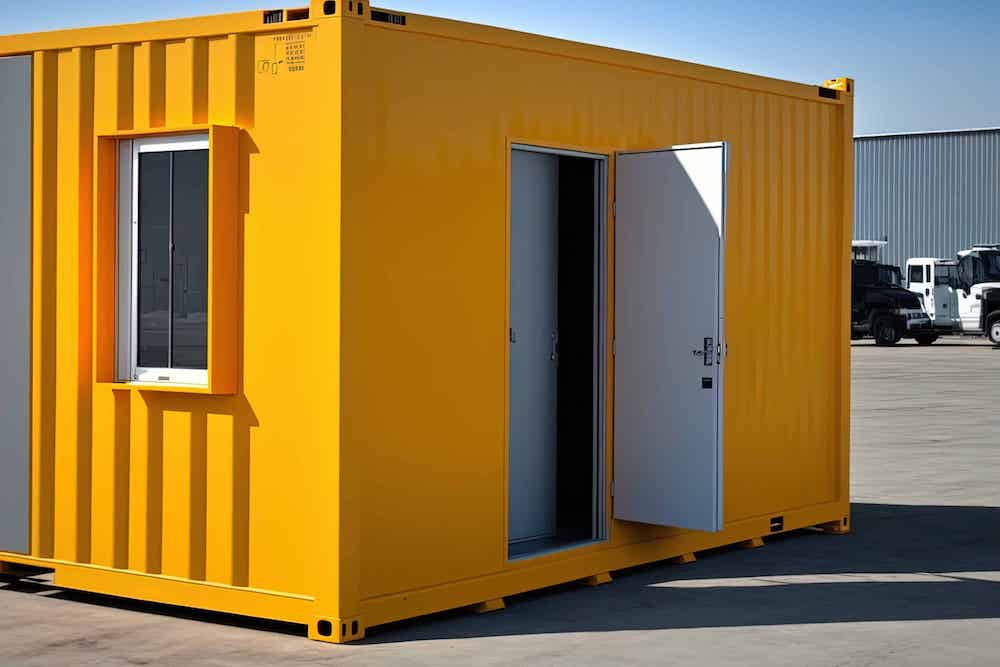
Shipping containers are deceptively customizable under their uniform exterior. You can cut in additional doors for easy-access or installing windows for natural light. You can install shelving, racking systems, run electrical for lighting and power tools, or even HVAC for climate control. The steel walls provide great anchor points for customization while maintaining structural integrity. For Central Texas properties, that means turning a container into a modern Hill Country workshop, a ranch tack room, or secure storage for ATVs, tractor attachments, and lawn equipment.
Space Efficiency
The uniform, rectangular shape of a shipping container makes it very easy to plan for and maximize use of space. Unlike an irregularly shaped shed, you can optimize the use of every inch of interior space with shelving and organization systems. The flat roof also provides some additional storage potential, and containers can be stacked if you need vertical expansion. The standard sizes (20ft or 40ft) also make it easy to know exactly how much storage you’re getting with the dimensions of the container.
Portability
Life happens and your storage needs may change. A shipping container shed unlike a traditional wood or vinyl shed that’s pretty much permanent once constructed. Containers can be picked up and relocated if you move, redesign your property or even reposition for more optimal access. This portability also means in many jurisdictions that it’s not considered a permanent structure which can help with permitting.
Environmentally Friendly
Giving a retired shipping container a second life as a storage shed is one of the most sustainable types of recycling you can do. The steel box has already been built and performed its shipping yard duty; otherwise it would just be sitting in a yard or being scrapped. A shipping container shed is the best of all worlds — you’re making an environmentally-friendly choice while also receiving an unparalleled product.
Cons of a Shipping Container Shed
Price
A brand new shipping container will set you back more cash upfront than most budget-friendly wooden shed kits. But here’s where you have to stop thinking about this as a shed purchase, and instead start thinking about it as a solid investment. Add in the 25+ year life expectancy, minimal maintenance and security costs, and you won’t have to replace it ever. Your total cost of ownership over the long-term is far lower than the cost of buying and maintaining multiple old-school sheds.
Permits and Zoning
In some locations, you may need to obtain zoning permits or HOA approval before placing a shipping container on your property. Some cities allow them as temporary structures (no permit needed) while others consider them a permanent building. Regulations vary, so check with your local government ahead of delivery. The good news is that municipalities have become savvier about containers in recent years. Many have streamlined their zoning policies as they see more people repurposing them for storage and buildings.
In the Austin metro area, there are a few specific things to keep in mind. Within the City of Austin limits, backyard structures count toward your property’s maximum impervious cover—a crucial rule tied to watershed protection regulations. Make sure to check your lot’s allowable footprint before placing a container. There’s also a meaningful difference between being inside strict city limits (Austin, Round Rock, Georgetown) versus being in unincorporated areas of Travis, Williamson, Hays, or Bastrop counties, where building permits for agricultural or simple storage sheds are often far easier to navigate. And if you’re in a suburban Austin neighborhood with an HOA, expect strict architectural guidelines. In those cases, exterior modifications like cedar board-and-batten siding or paint colors that match the Hill Country palette—think limestone gray, dark bronze, or desert tan—can go a long way toward gaining approval.
Condensation
The same steel construction that makes containers so durable also creates a risk for condensation issues. Temperature changes between the outside and inside environment can cause moisture to form on the interior walls and ceiling, sometimes known as “container rain.” Ventilation takes care of this easily, but it’s something to consider if you plan to store moisture-sensitive goods.
Heat Transfer
Steel is also very good at conducting heat, meaning a shipping container will heat up quickly in the summer sun and also lose heat fast in the winter cold. In Central Texas, this is especially important—Austin averages dozens of days over 100°F every summer, and an uninsulated container can turn into an oven in July and August. If you plan to use the interior as a workshop or store any temperature-sensitive materials, you will have to insulate it. We recommend closed-cell spray foam insulation, which acts as both a thermal barrier and a vapor barrier against Austin’s humidity. Adding a radiant barrier or reflective roof coating—like elastomeric paint—is also a smart move to bounce Texas solar radiation. Solar-powered roof exhaust vents are another great option; they take advantage of all that Central Texas sunlight to keep heat moving out of the container without tapping into the electrical grid. It’s not a major issue, but one that adds to your setup cost.
Aesthetics
A standard shipping container in its original condition has an industrial appearance that will not be to everyone’s taste, or that may clash with the architectural style of an existing residential property. This issue is readily addressed with a coat of exterior paint, wood cladding or landscaping. In Central Texas, many property owners finish their containers with cedar accents, ranch gates, or landscaping with Texas natives like agave, yucca, and native grasses to blend the industrial steel box into the Hill Country landscape. In any case, many people like the modern industrial style and many more will modify or “finish” the exterior to their own requirements.
Converting a Shipping Container into a Shed
Selecting a Container
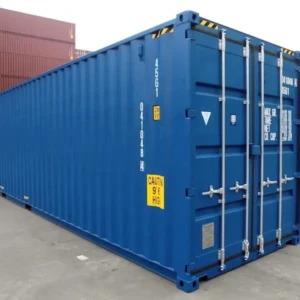
Size: The most common sizes are 20ft (160 square feet of floor space) and 40ft (320 square feet). A 20ft unit is ideal for lawn mowers, garden tools, and seasonal decor items. A 40ft container works for big machinery, larger workshop set-ups, or commercial inventory.
Condition: New “One-Trip” containers from overseas are in pristine condition; if you care about appearance, or maximum lifespan, get a new unit. Look for used containers marked “WWT” (Wind and Water Tight) or “Cargo Worthy.” Used containers will have cosmetic and surface wear but still be structurally sound and weatherproof. They will be cheaper and are a good option if you plan to use the container for simple storage.
Site Preparation
Foundation: Containers need a flat, level surface to ensure doors open and close smoothly. A compacted gravel pad, concrete slab, or railroad timbers at each corner, are all common foundation choices. A foundation only needs to support the corners as that’s where the container’s weight is focused. The steel frame efficiently distributes the weight.
In Central Texas, your soil conditions will determine the best foundation approach. If your property sits on Blackland prairie clay—common in East Austin, Pflugerville, Manor, and Elgin—that soil expands when wet and shrinks when dry, which can shift a container out of level over time. A compacted crushed limestone base pad (minimum 4–6 inches) or concrete piers will keep things stable. If you’re west of IH-35 in areas like Dripping Springs, Lakeway, or Oak Hill, you may be dealing with Hill Country limestone bedrock. In that case, pre-leveling with gravel or setting concrete footings directly on the solid rock is the way to go.
Delivery Access: Confirm access for the delivery truck, as well as the crane or tilt-bed system that will lower the container. You will need at least 12 feet of width and 14 feet of overhead clearance (including overhead power lines) for the delivery route. Shipping containers are very heavy; budget for about 8,000 pounds for a 40ft unit when empty. In the Austin metro area, you’ll also want to plan for tight suburban driveways, narrow Hill Country roads, and low-hanging live oak branches that can obstruct delivery routes—flagging those clearance issues ahead of time can save a lot of headaches on delivery day.
Customisation and Modification
Entry Access
Standard cargo doors will work if your only need to access the shed occasionally to store seasonal equipment or overstock. If you will be accessing your container on a daily basis to work or run your business operations, you should look into adding a personnel door, or “man door,” to the side of the unit. This allows much easier access without the need to open the heavy-duty cargo doors every time you need to enter or exit.
Ventilation
Passive air vents placed in the gable ends or sidewalls are a good way to avoid condensation. Louvers can be used, which will also allow air to circulate while still maintaining a secure area. For high-value or moisture-sensitive storage, active ventilation or even dehumidification can be considered. Solar-powered roof exhaust vents are an especially smart addition in Central Texas, where abundant sunlight powers them for free and keeps heat cycling out of the container all summer long.
Insulation
Insulation will be required if you will be working in your container, or if you will be storing temperature-sensitive goods. In Central Texas, closed-cell spray foam insulation is the top recommendation—it creates a thermal barrier and doubles as a vapor barrier against the region’s humidity. Adding a reflective roof coating like elastomeric paint to the exterior provides further protection against intense solar radiation. Rigid foam panels are a less-expensive and DIY-friendly option.
Finishing Touches
Interior
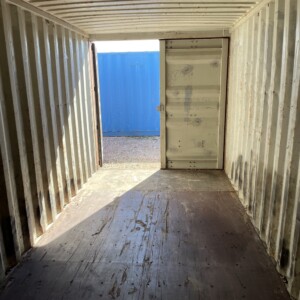
Wall-mounted shelving, pegboard for tools, or a custom racking system are all good ways to get more out of your storage space. The corrugated steel walls offer good anchor points for sturdy shelving and storage solutions. Rubber floor mats can be laid over the plywood subfloor for added comfort if you will be regularly working in your container.
Lighting and Power
Solar-powered LED lights are the easiest option that requires no electrical work. If you are outfitting a full workshop, you can run conduit from an external power source to the container and run outlets, overhead lighting, and even HVAC units. For permanent electrical work, always hire a licensed electrician.
Exterior
The easiest way to protect your investment and help your container blend in with your other buildings is a fresh coat of rust-inhibiting paint. Light colors will reflect heat, while darker shades can help your container stand out as a modern accent piece. Some property owners even choose to add wood siding or brick facades to give the container a more traditional appearance. In Central Texas, finishing with cedar board-and-batten accents, ranch-style gates, or landscaping with native plants like agave, yucca, and ornamental grasses is a popular way to tie the container into a Hill Country modern or ranch aesthetic.
Buying vs. Renting
Renting
Pros: Renting is a much lower upfront cost and works well for temporary situations like a construction site, seasonal excess inventory, or even just to try before you buy. Rental prices usually include delivery and pickup, so it is very convenient.
Con: Modification is completely out of the question with rental containers. You can’t cut out doors or windows in a container that you are renting. It is even possible to spend more on long-term rentals than the container is actually worth. Monthly minimums in rental contracts can be quite expensive for long-term storage.
Buying
Pros: The most obvious benefit of buying over renting is that the container is yours. You can do whatever you want to the container to customize it to your exact needs. Cut holes, paint it, insulate it, etc. In the long term, buying makes more sense, especially if you plan on using the container for storage for more than five years.
Cons: Buying a container is more expensive than renting one. You also have to be responsible for maintaining it, even though we’ve gone over that containers don’t need any real maintenance. Additionally, if you buy one, you are responsible for delivery and permitting, if your city requires it.
Say Goodbye to Shed Problems for Good
Containers solve every single problem that a typical wooden shed has. They are rot-proof, warp-proof, and just about maintenance-proof. They are a bit of an investment at first, but it is a smart investment for anyone that is tired of replacing an inexpensive, flimsy, easily destroyed shed every couple of years. They are secure, durable, and flexible. Shipping containers are the new, modern solution for backyard storage units.
Are you ready to upgrade your storage solution? Give Steel Box Shipping Containers a call today. We can help you find the right size container for your needs at the most competitive rental and purchase rates. We proudly serve Austin, Round Rock, Georgetown, San Marcos, Dripping Springs, and the surrounding Central Texas region—and we can deliver virtually anywhere in the area.