You’ve seen them driving around Austin recently. Converted steel boxes that become coffee shops. Shipping containers that are boutique breweries, pop-up retail, or entire office buildings. What was once an architectural novelty is quickly becoming one of the most common methods of construction for small businesses and commercial developers across the country.
Shipping container structures are here to stay. They aren’t a fleeting trend; they’re quickly becoming a practical construction standard. Businesses across Texas aren’t choosing them because they’re trendy (although they are cool). They’re choosing them because they save time, lower overhead, and allow entrepreneurs to build an asset instead of leasing from a landlord.
At Steel Box Shipping Containers, we provide the raw materials for any amazing container project: the container. We provide developers with the boxes to build multi-unit retail developments and first-time entrepreneurs with the space to stop paying rent. We offer new one trip containers, used cargo-worthy containers, and every variant in between.
That’s why we put this guide together. If you’re looking to design, plan, and execute a shipping container commercial building in Texas, this guide has everything you need to know. RAW construction statistics, local permitting tips – you name it.
Speed, Cost, and Durability
Speed to Market: Up to 60% Faster
Time equals money. In commercial construction, this adage is never truer than when you consider the speed to market of a container building. Traditional brick and mortar construction can take 6–12 months to complete. An equivalent shipping container building — think one 40-foot container office building or two-container wide retail build — can be erected in as little as 6–8 weeks.
This isn’t hyperbole. It’s simple math. Most alterations to a shipping container — framing out walls and doors, insulating, electrical rough-ins, window cutouts — can happen in the controlled environment of a shop floor while site prep is occurring simultaneously. Containers can be 80% complete by the time your foundation piers are poured. There are no delays due to weather, sequential subcontractor schedules, or drywall curing times.
Builds using containers can be 60–70% faster to completion than traditional builds. Expect simple builds to take 6–8 weeks instead of 6+ months.
The Cost Reality Check
A bare 40′ container will run you $3,500–$6,500 from Steel Box depending on condition and market. That’s just the container.
A finished, code conforming commercial office complete with spray foam insulation, HVAC, electric panel, plumbing stub-outs, exterior finish work and storefront glass will set you back more. But you’re looking at anywhere from $150 to $350 per square foot for a finished commercial build out, depending on finishes and local labor costs.
What you save comes in two forms that traditional construction can’t touch:
- Decreased labor via offsite fabrication
- Little to no foundation work — piers vs. full slab
- No need to build/frame the walls. The container IS the building.
- Quicker to lease/begin business = Quicker ROI
It all adds up! You have created an asset on your property that you built to your schedule (and usually at a fraction of the time) of a traditional construction project.
From the Ground Up: Superior Construction
Shipping containers aren’t recycled boxes. Constructed with Corten steel (a marine grade, weathering steel), these ISO certified shipping containers are built to hold up against some of the toughest environments on Earth. When loaded correctly, a 40 foot container can withstand 31 tons of vertical pressure and wind speeds up to hurricane force.
That toughness is what makes a container building excel in Texas. High winds, ultra-violet light and severe humidity fluctuations can wreak havoc on a traditional wood frame building over time. When you start with a Corten steel box, you start with a building that will outlive your business.
Advanced Commercial Use Cases
Containers are being deployed for a wider variety of commercial applications than ever before, and the results are game-changing for business owners that want to own their build instead of leasing.
Medical, Research, and Technology Facilities
Mobile clinics, vaccine storage facilities, testing labs — you name it. Medical and technology industries are beginning to utilize modified containers for strong, secure, and easily transportable builds. The easily sanitized, completely sealed-in environment makes a container an ideal solution for healthcare and scientific businesses that need durable mobile or semi-permanent facilities.
Right here in Central Texas, modular data centers are a huge opportunity. With Austin’s growing tech industry – and the overall high cost of traditional data centers – container server farms are becoming a more reasonable option for large companies. Secure, climate-controlled containers with properly-designed MEP (mechanical, electrical, plumbing) can support entire server racks in a single modified 40-foot container.
Multi-Level Complexes
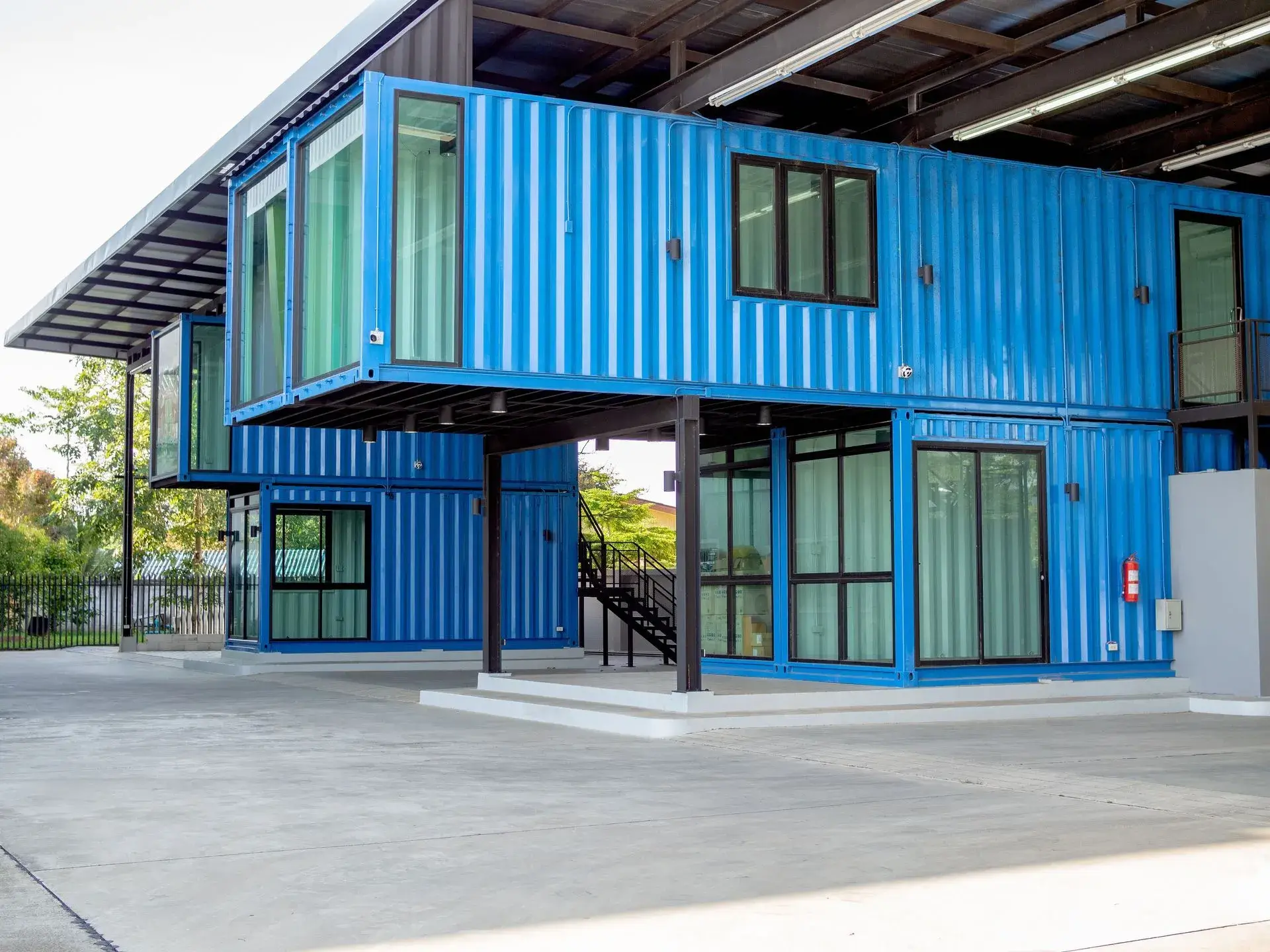
Containers can also be stacked up into impressive high structures! Developers are using 40 foot High-Cube containers (which provide 1 additional foot of interior height) to build multi-story retail destinations, offices spaces and mixed-used venues with rooftop decks.
Corten steel containers are designed to handle tremendous vertical loads, so stacking multiple containers is completely feasible with the proper engineering and connector hardware. Rooftop decks are especially trendy right now for Austin’s food and beverage industry, where outdoor seating is key to attracting customers.
Industrial Flex-Space
More and more tradespeople, small manufacturers and specialty retailers are turning to the flex-space model: used cargo-worthy container for workshop/fabrication space (the “dirty” side) with a new One Trip container built fresh as a showroom/client facing office (“clean” side).
The juxtaposition of old vs. new actually works to your advantage. The faded, well-traveled look of a used container says “crafted with care,” while its shiny new neighbor says “professional.” Custom fabricators, auto shops, woodworkers and others can really set themselves apart from the typical brick-and-mortar by having this efficient and affordable clean/dirty split.
Commercial Container Size Cheat Sheet
Before diving into your floor plan, it’s helpful to have a quick reference for the “footprint” you are designing in. The outside width is consistent, but that additional foot of headroom in a High-Cube can really make or break your commercial build. Here’s your container size cheat sheet for commercial spaces.
| Container Type | Exterior Dimensions (L x W x H) | Interior Sq. Footage | Best Commercial Use |
| 20′ Standard | 20′ x 8′ x 8’6″ | ~150 sq. ft. | Coffee bars, ticket booths, or single-office “pods.” |
| 40′ Standard | 40′ x 8′ x 8’6″ | ~300 sq. ft. | Retail boutiques, dual-office suites, or long workshops. |
| 40′ High-Cube | 40′ x 8′ x 9’6″ | ~300 sq. ft. | Top Pick: Best for retail/office (allows for HVAC & lighting in the ceiling). |
Technical Breakdown: Building Commercial Grade
Underneath all the trim and finishes, a container is still a steel box. In order to make that box code compliant, customer-ready, and fit for purpose as commercial space, there are some key systems to consider. Here’s what goes into turning a container into a professional-grade build.
Climate Control: Don’t Fear the Texas Heat
“What about in the summer?” is the question we get most often from business owners around Texas. Won’t those huge steel walls just turn it into an oven?
Sure, if you don’t insulated it. But that’s kind of the point: any commercial container build intended for year-round occupancy in a hot climate needs insulation as part of the plan. An empty steel box is going to do exactly what you think an empty steel box will do in the Texas summer: get really hot, really fast.
But so will any uninsulated building. The solution? Closed-cell spray polyurethane foam (SPF) insulation applied directly to the interior walls and ceiling. Closed-cell SPF has several benefits:
- It has R-values of between 6 and 7 per inch
- Creates an air-tight thermal barrier
- Adds structural strength
- Is moisture-resistant
All important features when dealing with Texas’s hot, humid summers and sudden cold fronts.
Spray foam insulation paired with a correctly-sized mini-split HVAC system or ducted unit secured within the ceiling void of your container will keep interior temperatures where you want them without breaking the bank. HVAC actually ends up costing less for a container build than a traditional building thanks to its small footprint.
Fenestration: Breaking Out of The Box
Few changes to a commercial container build have as much impact as taking out a full sidewall and replacing it with storefront glass. The entire side panel of a 20-ft. container (approximately 19′ wide x 7.5′ high) can be eliminated and replaced with commercial storefront glazing from floor to ceiling. A steel header beam is installed across the opening to redistribute the load.
The result is jaw dropping. Where there was once an imposing steel box, you now have an open, light-filled and welcoming retail or office environment that feels custom built and decidedly not industrial. When you add aluminum storefront framing, transoms, or a glass roll-up door, you’ve got a space that opens to the outside — and bathes your interiors in natural light, which we all love and respond to.
Utilities: Planning Your Stub-Outs
Container builds should plan for easy connections to utilities before the build even starts. Electrical conduit, plumbing supply/drain lines, and data/telecom conduit should be integrated into the floor structure or wall panels during the shop build phase. These are commonly referred to as “stub-outs” by contractors.
Taking the time to do this before the build dramatically streamlines your on-site connection to utilities. You show up with a container that is ready to plug in. Your electrician no longer needs to run from the electrical panel to the container. Your plumber no longer needs to thread pipe through the walls. What would take days on a traditional build can be accomplished in hours.
How to Handle Permitting, Zoning & Code
Permitting and zoning is where container projects get stalled, fined, or denied outright. A little knowledge now can prevent massive headaches later.
Building Codes & ICC Documentation
Shipping container homes are regulated by the International Building Code (IBC), which is implemented on a local level by the building department in your town or city. The International Code Council (ICC) recently released a How‐To Guide for building departments regarding container structures. It identifies cargo containers as “industrialized buildings” if they are constructed at a location other than their ultimate site.
Commercial projects should involve a fabricator who is certified by the International Accreditation Service (IAS) or other similar entity. Containers built by IAS certified companies are constructed to meet IBC guidelines for offsite building, allowing you to obtain a building permit with virtually all the engineering work already done.
Permitting in Austin and Texas
Permitting in Austin and Texas tends to depend on whether your building will be in a Commercial or Light Industrial zoning district. That container coffee shop in a CS zone? It’s a whole different process than that container workshop in a LI zone. If you’re not sure where you fall, you can schedule a free pre-application meeting with Austin’s Development Services Department (DSD) and avoid weeks of frustrating email exchanges. Beyond Austin, permitting requirements tend to be more relaxed in small and medium-sized Central Texas municipalities (especially in the Hill Country). You’ll still need to pull a building permit and have your commercial building inspected, but the process is often less formal.
Foundation Requirements: The Pier Advantage
Arguably, the biggest savings realized with container construction come in the foundation. Due to the fact that the container spreads its load over four corner castings (think reinforced steel fittings) containers generally only need a pier foundation instead of a concrete slab.
Concrete footings are poured at each corner of the container, with mid-span piers poured as needed for longer containers. Saving thousands in concrete and excavation fees, plus it’s all done in a fraction of the time it takes to pour a slab. Plus the ground underneath is left virtually undisturbed — which is a huge benefit on environmentally sensitive or drainage constrained sites.
New versus Used: Know When to Choose
Containers aren’t always built new, and sometimes budgets won’t stretch to a new unit. Learn how One-Trip containers used in the real world differ from used cargo-worthy containers so you can make an informed decision for your application.
New / One-Trip Containers : Best for High-Visibility Builds
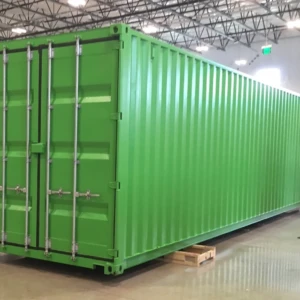
A One-Trip container has only traveled once – often just from a factory in Asia to a port in the U.S. – and arrives in “new” condition. The walls are dent-free and free of rust or patch repairs. The flooring is clean hardwood or bamboo. The exterior paint is even and free of graffiti or markings.
Best Suited For: Medical clinics, upscale retail, professional offices, client-facing showrooms, any situation where a smooth pristine exterior is part of your brand’s presentation.
If someone who pays you money is going to be walking up to your container, there’s a very different message sent by a One-Trip container versus an aged used container. It’s a subtle but important consideration for your brand.
Used / Cargo-Worthy Containers : Best for Function-Forward Builds
A used cargo-worthy container has been inspected and deemed safe to transport goods, but they’ve otherwise seen many years of wear-and-tear in that service. Dents, surface rust, and inconsistent paint are to be expected. The interior may be stained or damaged.
Best Suited For: Workshops, fabrication spaces, city bars and taprooms, storage-oriented businesses, or any application where your build benefits from an inherently industrial look.
Pro-tip: consider the sustainability angle you can lean into here. A used container is truly a recycled material – steel that would otherwise live out its days in a storage lot getting turned into useful commercial buildings. If your customers care about reducing their environmental impact, “this build is made from a recycled shipping container” is no longer a cliché, it’s a factual marketing point.
Build Your Next Commercial Building with Steel Box
Custom container buildings are no longer just a novelty. Modular construction using shipping containers is a proven, code compliant method of creating permanent structures for medical providers, tech startups, retailers, hospitality businesses and more from Texas to Tennessee. Container buildings go up fast, are strong and are one of the most versatile options we’ve seen for business owners who need more space.
We’ve delivered containers to builders, developers and entrepreneurs all over Central Texas. We carry new One-Trip containers, used conex containers and specialty sizes including 20′, 40′ and High-Cube containers. We can walk you through which container is right for your build, answer modification and delivery questions and connect you with fabricators and contractors from our network.
Ready to get started? Give Steel Box Shipping Containers a call today and let’s talk about your project. Whether you just have a napkin sketch or are ready to place an order, we can help you find the right box and build it out to last.